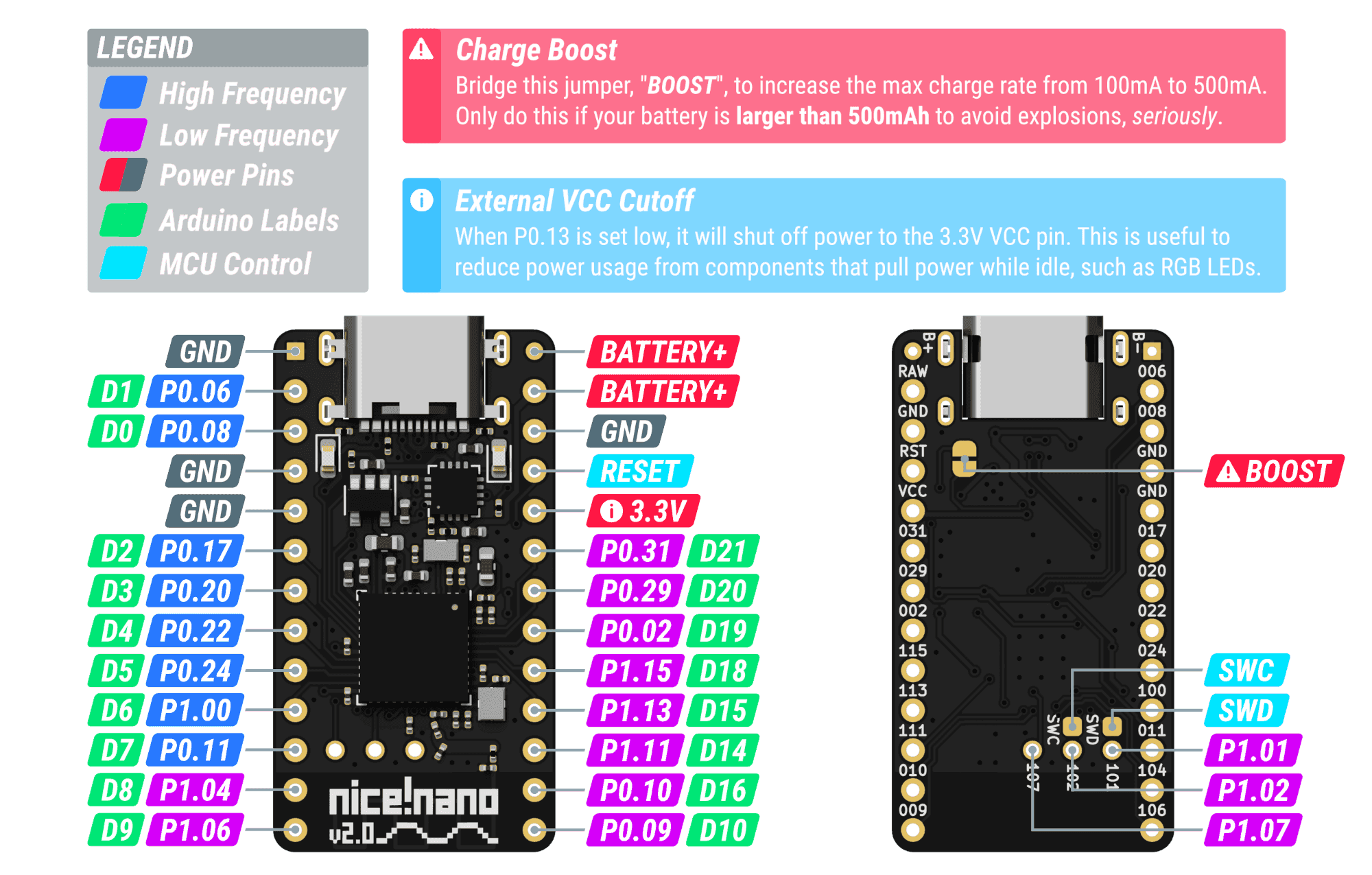

GPIO-Pinliste & Funktionen
| Board-Pin | nRF52840 Pin | Digital I/O | ADC | PWM | I²C | SPI | UART | Hinweis |
|---|---|---|---|---|---|---|---|---|
| D0 | P0.08 | ✔ | ✔ | ✔ | – | – | RX | UART RX |
| D1 | P0.06 | ✔ | ✔ | ✔ | – | – | TX | UART TX |
| D2 | P0.17 | ✔ | ✔ | ✔ | – | – | – | GPIO |
| D3 | P0.20 | ✔ | ✔ | ✔ | – | – | – | GPIO |
| D4 | P0.22 | ✔ | ✔ | ✔ | – | – | – | GPIO |
| D5 | P0.24 | ✔ | ✔ | ✔ | – | – | – | GPIO |
| D6 | P0.15 | ✔ | ✔ | ✔ | – | – | – | GPIO |
| D7 | P0.13 | ✔ | ✔ | ✔ | – | – | – | GPIO |
| D8 | P0.11 | ✔ | ✔ | ✔ | – | – | – | GPIO |
| D9 | P0.09 | ✔ | ✔ | ✔ | – | – | – | GPIO |
| D10 | P0.10 | ✔ | ✔ | ✔ | – | CS | – | SPI CS |
| D14 (MISO) | P0.23 | ✔ | ✔ | ✔ | – | MISO | – | SPI |
| D15 (MOSI) | P0.21 | ✔ | ✔ | ✔ | – | MOSI | – | SPI |
| D16 (SCK) | P0.19 | ✔ | ✔ | ✔ | – | SCK | – | SPI |
| D18 (SDA) | P0.26 | ✔ | ✔ | ✔ | SDA | – | – | I²C |
| D19 (SCL) | P0.27 | ✔ | ✔ | ✔ | SCL | – | – | I²C |
| LED | P0.13 / P1.x | ✔ | – | ✔ | – | – | – | Onboard LED |
Wichtige Funktionen erklärt
Kommunikation
- UART:
- RX → D0
- TX → D1
- I²C:
- SDA → D18
- SCL → D19
- SPI:
- SCK → D16
- MOSI → D15
- MISO → D14
- CS → D10
Gute Standard-Belegung für Displays, Sensoren etc.
Analog & PWM
- ADC (SAADC, 14-bit): auf vielen Pins verfügbar (z. B. D0–D10)
- PWM: fast alle GPIOs unterstützen PWM (Timer-basiert)
Onboard-LED
- Meist auf D7 oder D13-ähnlichem Pin (z. B. P0.13)
- Ideal für Testprogramme (
blink)
Wichtige Hinweise
- Alle Pins sind 3.3 V-Logik! → NICHT 5 V tolerant
- Pin-Mapping ist flexibel:
→ nRF52 erlaubt Remapping vieler Funktionen (ähnlich ESP32, aber strukturierter) - Unterschiede je nach Board:
→ nice!nano, Adafruit, China-Clones haben leicht andere Zuordnungen
Typische Anschluss-Beispiele
- OLED Display (I²C) → D18 (SDA) + D19 (SCL)
- SPI TFT Display → D16/D15/D14/D10
- Sensor (analog) → z. B. D2 oder D3
- Serielle Kommunikation → D0/D1
Fazit
Das nRF52840 Pro Micro kombiniert:
- viele flexible GPIOs
- starkes BLE/Thread-Funkmodul
- USB-Device-Funktion
- und einen sehr Arduino-freundlichen Formfaktor
Besonders gut für Wireless-Keyboards, Wearables, Sensor-Nodes und USB-Geräte geeignet.
Hier sind die technischen Spezifikationen des Entwicklungsboards AYWHP Pro Micro NRF52840 bzw. ähnlicher Pro Micro NRF52840‑Boards – also Boards im Pro Micro‑Formfaktor, basierend auf dem nRF52840‑SoC, die besonders für BLE/Zigbee/Thread‑Projekte, USB‑Geräte und energieeffiziente IoT‑Geräte genutzt werden
Mikrocontroller (nRF52840 SoC)
- Chip: Nordic Semiconductor nRF52840 (ARM Cortex‑M4 FPU)
- CPU‑Takt: 64 MHz
- Flash‑Speicher: 1 MB eingebettet
- SRAM: 256 KB RAM
- Architektur: 32‑Bit ARM Cortex‑M4 mit Floating‑Point‑Einheit + DSP
Drahtlose Konnektivität
- Bluetooth 5.0 / BLE (Low Energy) – inkl. Long Range & 2 Mbit PHY
- Thread & Zigbee Unterstützung (nativ im SoC) – abhängig von Software/Stack
- 2.4 GHz Funk mit eingebauter Antenne (Board‑abhängig)
Peripherie & Schnittstellen
- Digitale I/O‑Pins: ca. 18 GPIOs verfügbar (Pro Micro‑Pinout)
- PWM: mehrere PWM‑Kanäle für LED/Motor‑Steuerung
- ADC: bis zu 6 Analog‑Eingänge (14‑bit SAADC)
- UART: 1 UART Hardware‑Port (TX/RX)
- I2C: 1 I²C‑Interface (SDA/SCL)
- SPI: 1 SPI‑Interface (MOSI/MISO/SCK)
- USB: Native USB Interface (USB‑CDC/USB‑Device) – nutzt die USB‑Funktion des nRF52840
- GPIO‑LED: Onboard‑LED (meist an einem definierten GPIO, z. B. D13)
Strom & Betrieb
- Betriebsspannung: 3.3 V Logik‑Pegeln (intern geregelt)
- USB‑Betrieb: Betrieb über USB‑C oder Micro‑USB möglich
- Li‑Po‑Akku‑Unterstützung: Viele Varianten haben Li‑Ion/Li‑Po‑Anschluss + Lade‑Schaltung (typ. 100 mA)
- Low‑Power‑Modi: Sehr niedriger Stromverbrauch im Sleep‑/Standby‑Betrieb (~20 µA) möglich
Mechanik & Formfaktor
- Formfaktor: Arduino Pro Micro‑kompatibel – gleiche Pin‑Anordnung wie klassische ATmega32U4‑Pro Micro Boards
- Maße & Layout: kompakt, leicht in breadboards/Proto‑Shields nutzbar
Software‑Unterstützung
- Unterstützt Arduino Core für nRF52 (z. B. über Community‑Kerne), CircuitPython, Zephyr RTOS, nRF Connect SDK usw.
- USB‑Bootloader meist im Adafruit UF2‑Format integriert → per USB direkt flashbar
Typische Einsatzgebiete
- Wireless Peripheriegeräte (Keyboards, Gamepads)
- BLE‑Sensoren & Aktoren
- IoT‑Gateways und Funksteuerungen
- Batteriebetriebene Geräte mit lange Laufzeit
Zusammenfassung
ProMicro‑NRF52840‑Boards kombinieren einen leistungsfähigen nRF52840‑SoC mit großem Flash/RAM, BLE/Thread/Zigbee‑Funk, USB‑Unterstützung und einem klassischen Arduino‑kompatiblen Formfaktor – ideal für drahtlose Projekte, bei denen sowohl Funk als auch USB und Energieeffizienz gefragt sind.
Schematic
